Rocket Languages and Pimsleur are two of the most popular language learning apps in the world, and coincidentally (or perhaps not), are incredibly similar in terms of program structure and content. So how do you decide between the two? In this comparison, we break down course structure, pricing, and the advantages of both programs to help you understand how each one works. Simply put: while they appear nearly the same at first glance, there are some significant differences that make each one better for different learner types.
Sale: 60% OFF
Use Code: INSIGHT60
|
$150 lifetime |
Our absolute favorite app to learn a new language. With engaging audio lessons, detailed grammar instruction, and diverse drills, Rocket Languages has it all. |
Free 7-Day Trial
Sign Up Today
|
$20/mo |
Although similar to Rocket with in-depth audio lessons, Pimsleur stands out by offering a special driving mode, a more modern interface, and rigorous content. |
Video Review: Which App Wins?
In the video above, team member Bianca explains what we like and don’t like about each of these two programs.
Editor’s Choice
Rocket Languages
- Free Trial
- Money Back Guarantee
Pros
- Comprehensive curriculum centered around interactive audio lessons
- Accurate speech recognition technology (Google’s Web Speech API)
- Insightful grammar explanations
- Regular discounts (don’t pay attention to MSRP)
- Recently updated digital interface (desktop and mobile app)
Cons
- Lessons take some time to complete (45 to 60 minutes)
- Wish there were more visual elements within lessons

How The Rocket & Pimsleur Programs Work
Before I dive straight in and start listing what I like and dislike about each program, I want to provide some context about these two apps.
Most of the time, when I write comparison posts like this looking at language programs side-by-side, it’s fairly easy to differentiate between them and give advantages and disadvantages for each.
But comparing Rocket Languages and Pimsleur is a little bit harder. These two programs are nearly identical, from the course structure to their learning methodology and even the lessons themselves.
With that said, there are some key differences that make each program work better for a different type of learner. Keep that in mind as we go through the basic setup of both apps: for all they have in common, the differences between Rocket and Pimsleur are important to understand.
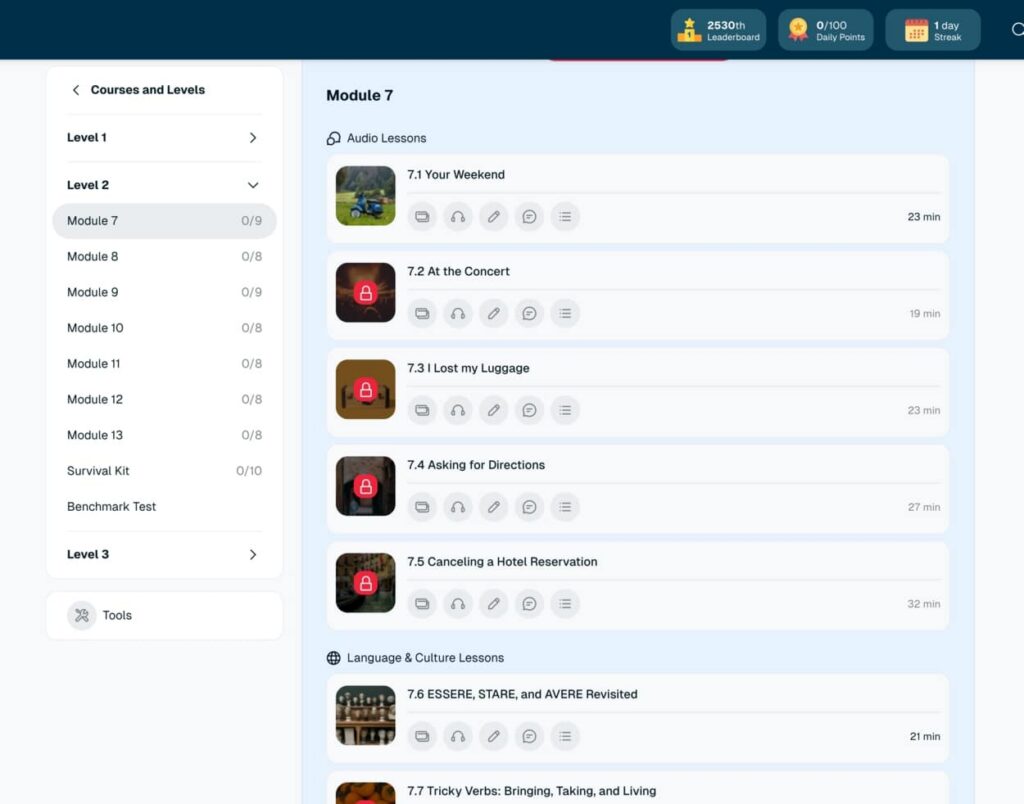
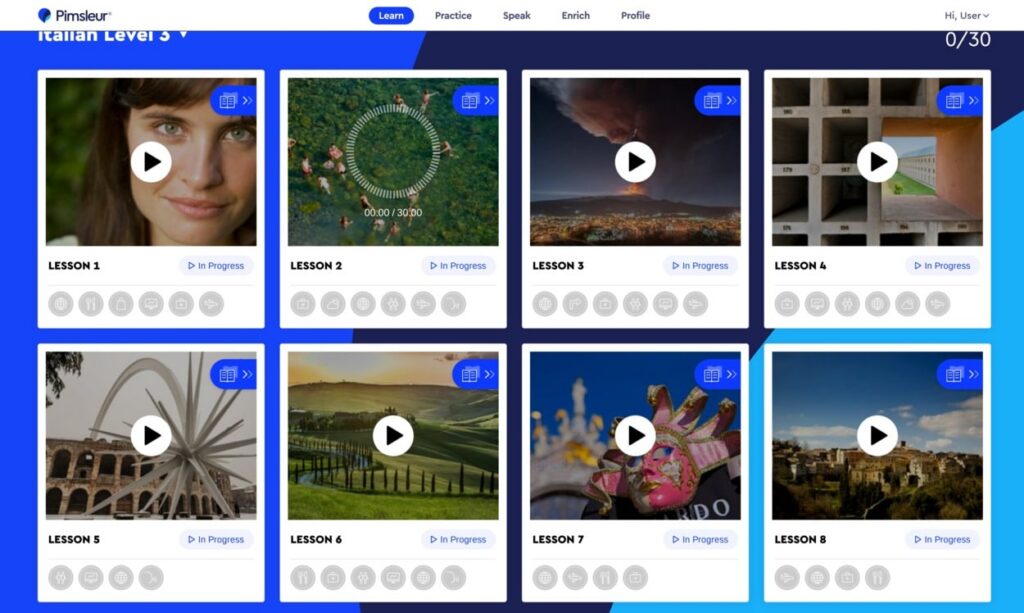
Let’s start with that high-level overview. From the top down, Pimsleur and Rocket are both built around audio lessons. Speaking practice and listening comprehension are at the core of each company’s approach, so they make audio lessons their key focus.
To start each module, each company will have you complete a 30-minute audio exercise where a moderator speaking in English walks you through a guided conversation step-by-step.
You’ll listen to a couple of sentences in the language you’re learning before the moderator briefly stops to explain the situation. In addition to listening, you’re constantly chiming in by answering questions and repeating phrases.
Both companies use this same core approach: everything is based on a 30-minute interactive audio lesson where you’re actively engaging with an in-depth conversation between fluent speakers.
Then after the audio lesson, both companies have you review what you just learned by working a variety of hands-on exercises. For Pimsleur, these reinforcement drills include reading drills, digital flashcards, quizzes, pronunciation training, and speed games. For Rocket, this means doing listen-and-repeat drills, flashcards, quizzes, and playing the part of the one of the two speakers from the lesson’s underlying conversation.
In this way, both Pimsleur and Rocket imitate the familiar structure of class followed by homework. You get your lesson, then do your assignments to drive it all home. This learning framework holds true for all of their courses, including French, Italian, and German.
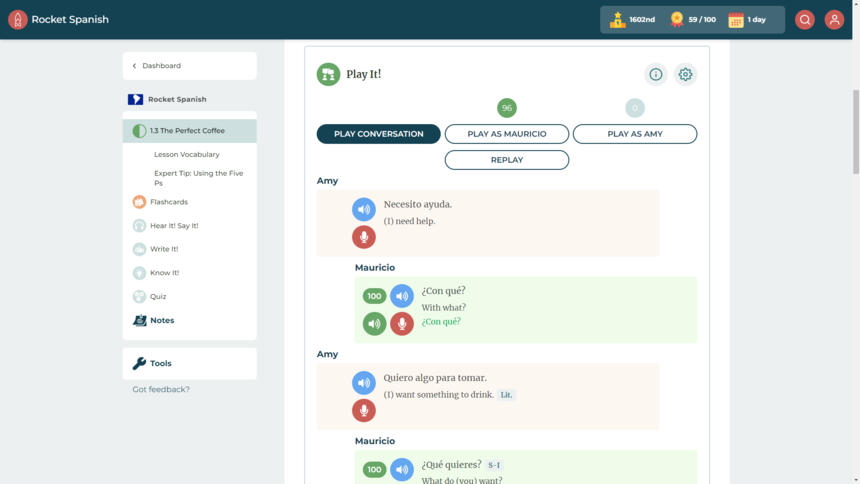
Plus, each company has a few extras around this main framework of audio lessons and reinforcement drills. Pimsleur has vocab bonus packs and pronunciation training through their AI-powered Voice Coach, while Rocket offers language & culture lessons, survival language kits, and a handful of community features like leaderboards and forums.
Each company’s lessons take about an hour to complete from start to finish and place a very strong emphasis on listening and speaking, with audio lessons as the main focus.
Cost Comparison
Now, let’s get into the nitty-gritty of where these two language apps differ. First up: price. Pimsleur and Rocket Languages have a very different purchasing structure.
Pimsleur offers a typical subscription model, where you pay-as-you-go for their app on a monthly basis. The Pimsleur Premium Plan, which gets you access to one language, costs about $20 per month.
Then there’s Pimsleur All Access. That gets you access to all 51 of Pimsleur’s languages for about $21 per month (i.e. $1 more per month). Either way, you’re looking at spending around $20 per month for Pimsleur.
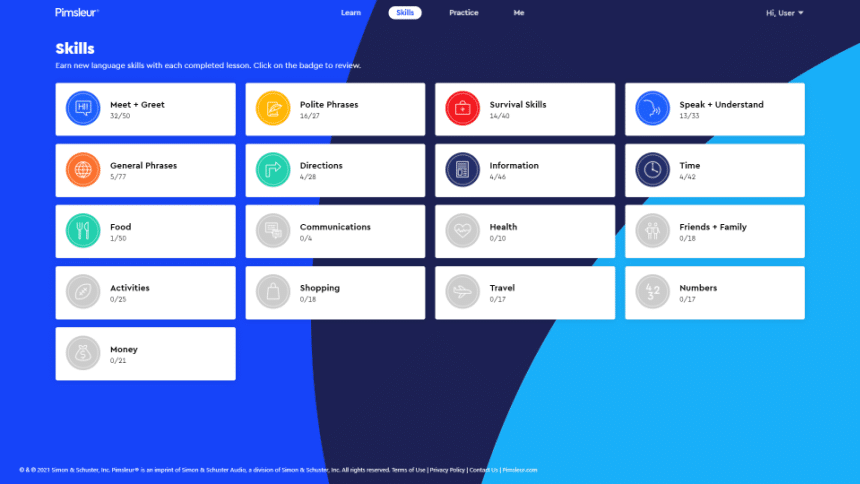
Rocket Languages doesn’t do the subscription model at all. Instead, Rocket only offers one-time purchase, lifetime plans. You buy the course and get access forever.
These packages range from about $150 to about $450, depending on how many levels you want to bundle together. It’s a fairly different model, and because of this, it’s somewhat difficult to compare costs here. It comes to down to how many months you plan to use each program to determine where that break even point is.
That being said, both companies are pretty aggressive with their discounting (especially Rocket Languages), and you can almost always find a discount to knock some money off, so make sure to look for coupon codes.
Why Rocket Languages Is Better Than Pimsleur
Now that I’ve laid out how the two programs operate, as well as how much they cost, let’s get into where each one has advantages over the other. Let’s start with Rocket Languages.
Use of Transcripts
The first major difference between these two apps is transcripts. When both companies’ audio lessons are rolling, Pimsleur does not provide a transcript of what is being said, while Rocket does.
Rocket rolls a transcript right under the audio lesson controls so you can see exactly what is being said and who is speaking.
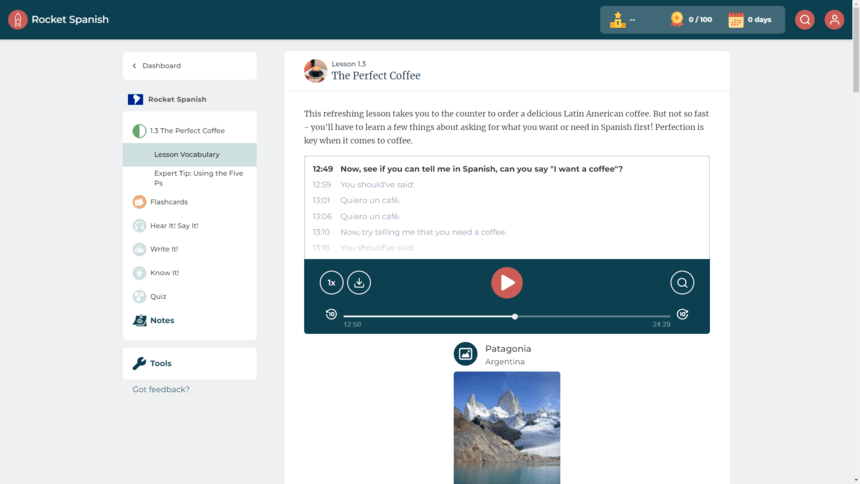
This might seem like a somewhat meaningless difference, but it is not. For me personally, I actually leaned on the transcripts pretty heavily.
I like to see how words are spelled, and it helped me follow along with the underlying conversation. For some people, it might not make a bit of difference, but if you’re more of visual person, it’s nice to get that combination of audio lessons that train your speaking and listening skills plus visual material you can follow along with so you don’t lose focus.
Reenact Conversations
If you want the most involved speaking practice out there, Rocket is the answer. Both programs provide tons of reinforcement drills, like matching exercises, to help the vocab stick. But Rocket Languages goes one step further by allowing you to play the part of one of the two actors in the underlying conversation. Let me explain.
Each audio lesson is built around a mock conversation conversation that forms the basis of the lesson, and the moderator uses it to make teaching points.
When the Pimsleur audio portion is done, it’s just done. You move on to the reinforcement drills. However, with Rocket, you can take the underlying conversation play the role of either one of the speakers to create a little back-and-forth dialogue.
When played in real time, the conversation might only be 5 or 10 minutes long (after you strip away all the notes and moderator teaching points), but I think it’s helpful to engage in this mock conversation in real time post-lesson. You’re in the hot seat, having to actually keep a full-length conversation going by yourself. This kind of challenge will push you to fluency much faster than simply clicking through drills. It’s a big advantage for Rocket Languages.
Grammar & Culture Explanations
Finally, if you want concrete grammar Instruction that makes sense, Rocket is the winner here. Before I explain their approach, it helps if you first understand Pimsleur’s perspective on grammar. Basically, Pimsleur does things a little differently than most apps.
Rather than providing direct grammar instruction, they let you discover grammar intuitively through the audio lesson. The moderator comments on grammar usage and discusses concepts like gender pronouns and verb conjugations, but it’s not deep or direct grammar instruction. For the most part, it’s on you to intuitively pick up how the language works.
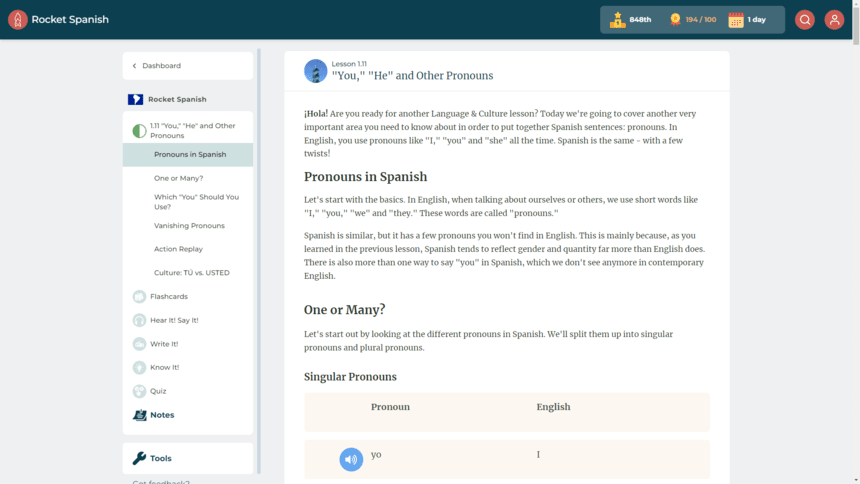
That’s fine, and this strategy has its own merits, but I prefer Rocket’s direct approach. They offer Language & Culture lessons in each unit that dive deep into a specific grammar principle, which they break down with short explanations, examples, and graphics. The point of these shorter lessons is to explain the structural differences between English and the language you’re learning.
Plus, Rocket also tosses in some important cultural tidbits along the way, which is cool. Pimsleur doesn’t offer any comparable cultural focus or grammar instruction. To me, that makes Rocket’s program both more thorough and more well-rounded.

Pimsleur
- 51+ Languages
- Money Back Guarantee
Pros
- Effective learning framework based on interval recall and anticipation
- Affordable monthly subscription plans
- Diverse set of practice drills following the audio lessons
- Driving mode so you can complete lessons in the car
- Modern digital platform
Cons
- Grammar is less of a priority
- Lessons can feel like they drag on at times

Why Pimsleur Is Better Than Rocket Languages
Now, let’s cover Pimsleur’s key highlights.
New Voice Coach
The first advantage for Pimsleur is their speech recognition software called Voice Coach. In my opinion, both companies’ speech tech is solid, but Pimsleur has an edge here.
Rocket actually uses Google’s web speech API, which is solid in its own right, but where they differ is in how they use their tech.
Rocket lets their speech software, Rocket Record, operate in the background of every speech-based reinforcement drill, while Pimsleur’s Voice Coach is more of a dedicated tool. You can jump into the Voice Coach anytime for extra practice whenever you want it.
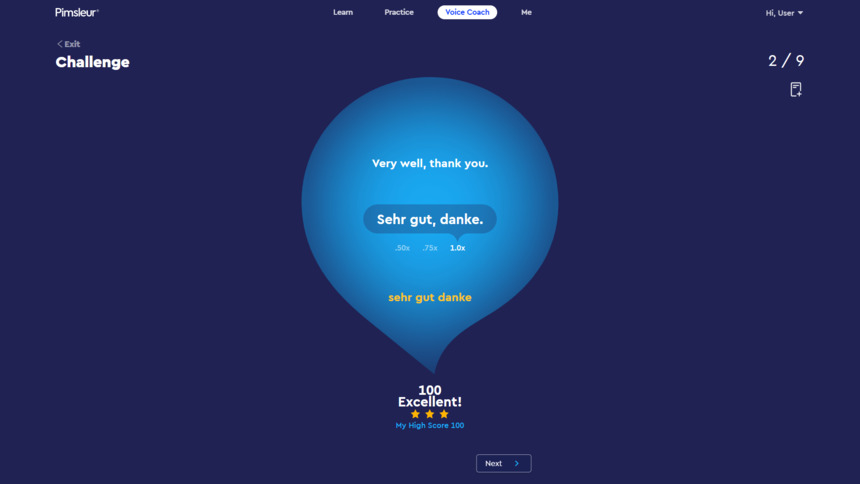
Now, don’t get me wrong, I like how Rocket does it, and getting a grade from 1-to-100 on all your drills is useful, but the new Pimsleur tech offers more targeted pronunciation practice.
Moreover, Pimsleur has a special feature in the tool called Challenge Mode. When you turn this on, you’ll be prompted in English to say a phrase in your target language with no hint about how to put it together.
This makes you think critically about what to say, and at the same time, you still need to nail your pronunciation. It’s difficult, but very helpful.
Between the two apps, I do like Rocket’s software a lot, but Pimsleur’s AI-powered setup and speech tools are game changing.
Driving Mode
Now, let’s say you don’t need the rolling transcripts that Rocket offers. Maybe you’re not a visual learner, or you prefer the challenge of picking up on the words yourself without being given the answer. Here’s the benefit of Pimsleur’s audio-only approach: you’re not tied to your phone.
You don’t have to be staring at a screen, watching the transcript roll by. You technically don’t have to watch the transcript with Rocket, either; it is optional. Yet, once you get hooked on the transcript, it’s hard not to use it after that point (at least, it was for me).
Due to this lack of transcripts with Pimsleur, you can hit play on the audio lessons and get something else done. You can do a lesson while you’re working out, doing laundry, walking the dog, whatever. I like that you can be productive with your time while still doing a lesson. It’s a huge bonus.
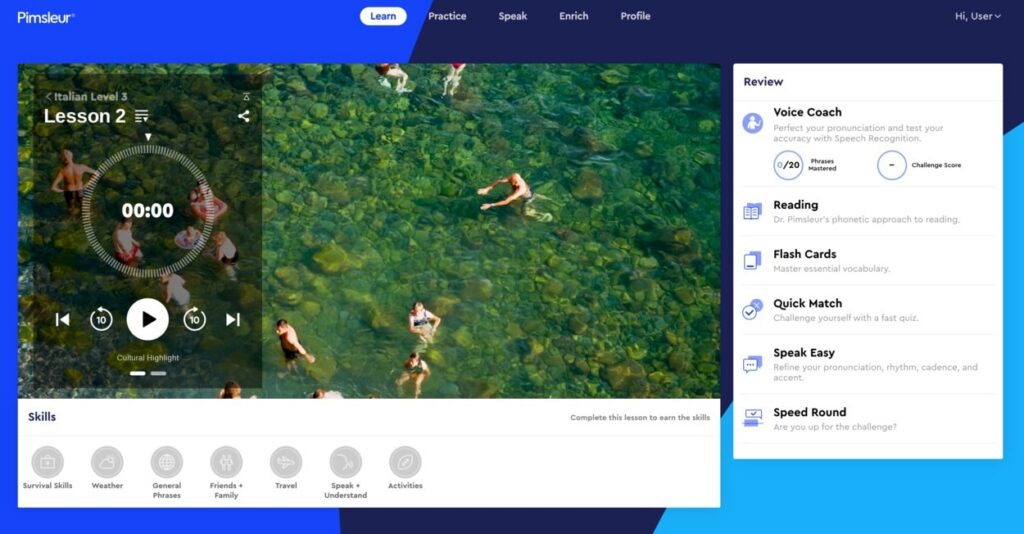
You can even do an audio lesson while driving because Pimsleur has a special driving mode, which is nice. If you’re constantly in your car or you have a long drive to work, this could make the difference in whether you actually have time to learn a language.
Better Digital Platform
The final advantage for Pimsleur is the user interface. Even though Rocket has done a nice job updating their interface lately, Pimsleur’s digital platform is about the best in the space in my opinion.
It is very easy to navigate, it’s fast, and it’s pretty. Everything is modern, snappy, and responsive, on both desktop and the mobile app. If using the best tech is important to you, I do think Pimsleur has a significant advantage.
Verdict: Which Language App Is Better?
So, should you use Rocket Languages or Pimsleur to learn a new language? Honestly, this is a tough comparison to tease out a clear winner. These are two of our highest rated programs, so you’re getting quality instruction either way. Yet at the end of the day, if I could only use one app, I would go with Rocket Languages.
Pimsleur’s approach definitely has its advantages, especially for busy commuters and anyone who wants the flexibility of knocking out some language learning while getting something else done. But for most learners wanting the most in-depth speaking and listening practice on the market, Rocket gives you every tool you need to rapidly advance. The rolling transcript works for visual learners, the grammar instruction makes language patterns easy to understand, and the opportunity to step up as one of the main actors in the long-form audio lessons pushes you like nothing else can.
Bottom line: if you want to become conversational fast, Rocket Languages will get you there.
The language courses from Pimsleur and Rocket Languages are actually very similar. They both revolve around interactive audio lessons with fluent speakers. Where they differ: Rocket Languages offers more in-depth grammar explanations, while Pimsleur offers the better digital experience.
Although it is an extremely close call, our team prefers the courses from Rocket Languages over Pimsleur’s. This is in large part due to their audio lesson transcripts and helpful grammar explanations.
Pimsleur is the more affordable option between the two. Pimsleur offers affordable monthly subscription options, whereas Rocket only offers lifetime plans.