If you’re serious about learning a new language, Rocket Languages and Babbel are two of our highest ranking apps. So how do you know which one is the right fit for you? In this article, we break down how each app works, pricing, and unique features so you can quickly figure out which language learning program is the right fit for your needs.
Sale: 60% OFF
Use Code: INSIGHT60
|
$150 lifetime |
Our favorite app by far to learn a new language. With audio lessons, detailed grammar instruction, and diverse exercises, Rocket Languages has it all. |
55% OFF + EXTRA 10%
Code: INSIGHT10
|
$8-$15/mo |
Our choice for language beginners and budget shoppers. The perfect app to start out, with fast-moving lessons that help you build a strong foundation. |
Video: Which Language App Is Better?
In the video above, Bianca from the Guide2Fluency team compares the language learning apps from Rocket and Babbel.
Editor’s Choice
Rocket Languages
- Free Trial
- Money Back Guarantee
Pros
- Program is more comprehensive overall than Babbel’s
- In-depth and interactive audio lessons feature native speakers
- Large discounts offered regularly (as much as 60% off)
- Dedicated lessons for grammar instruction
- Accurate speech recognition technology that utilizes Google’s web speech API
Cons
- Lessons are lengthy (45 minutes to an hour)
- No monthly subscription plans (only lifetime packages)
How Each Language Program Works
Before diving into the pros and cons of each app, I want to break down in detail how each language program works. This will help to provide some context.
Rocket Lessons
The Rocket Languages program is primarily built around audio lessons. To kick off each unit, you listen to a 30-minute conversation guided by an English-speaking moderator. You’ll listen to a sentence or two (or sometimes even just a phrase), and then the moderator will briefly stop to explain what’s going on, what you just heard. They’ll even have you engage in the conversation by answering questions and repeating key phrases.
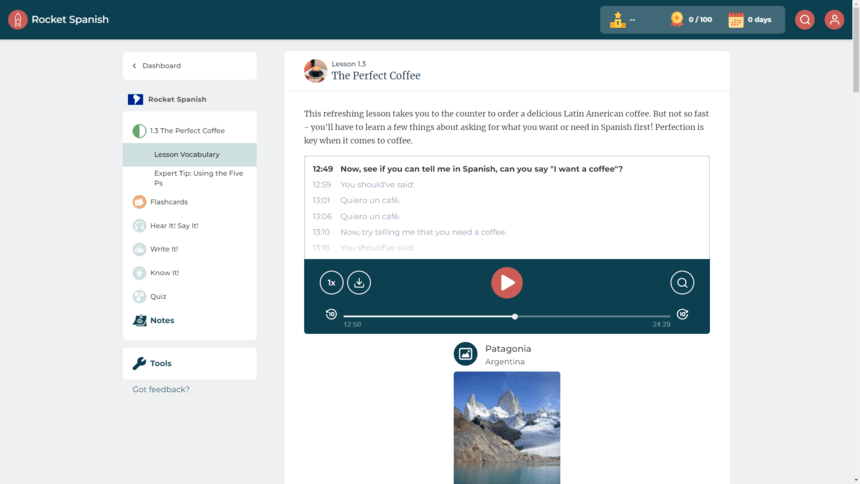
While you listen to the audio exercise, a rolling transcript plays underneath the audio controls so you can keep up and see how new words are spelled. After that, you work some reinforcement drills to make sure everything sticks.
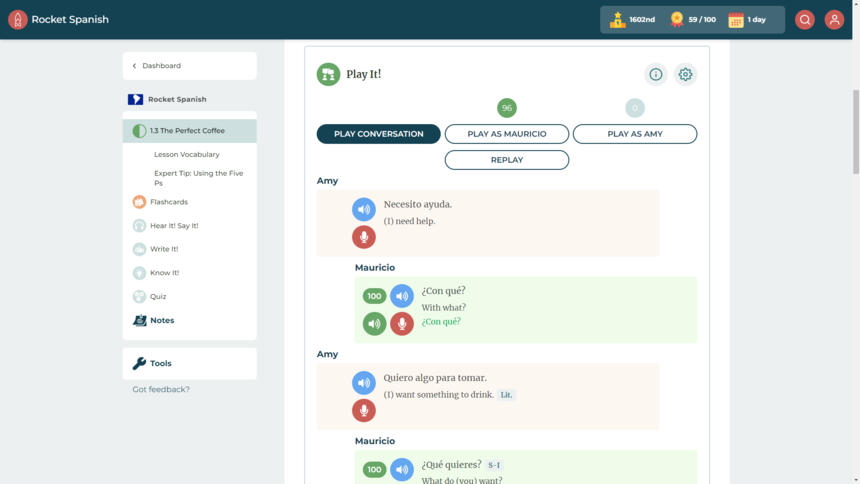
You’ll do listen-and-repeat drills, flashcards, quizzes, and my personal favorite, the chance to reenact the 30-minute conversation by playing the part of one of the two speakers.
It’s worth noting that the audio lessons and reinforcement drills are just the main portion of the Rocket program, regardless of whether you are learning Italian, French, or another language.
The other half of the lessons in each module are Language & Culture Lessons. In these lessons, Rocket dives deep into a specific grammar principle, with plenty of examples and graphics to help you make sense of everything.
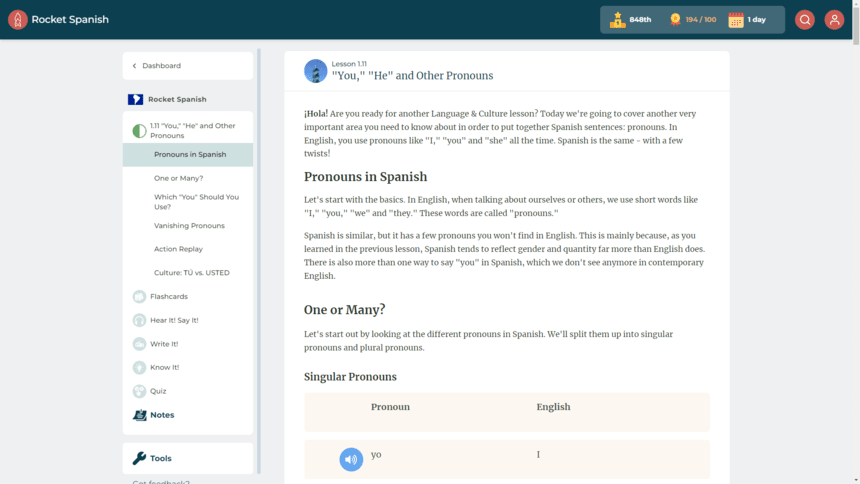
The point of these shorter lessons is to explain the structural differences between English and the language you’re learning. Rocket also tosses in some important cultural tidbits along the way in these lessons, which is nice. You really feel like you’re absorbing the culture along the way, not just picking up a few words here and there.
Babbel Lessons
If listening to extended conversations sounds overwhelming, you might prefer Babbel’s more gradual approach. Assuming you have no working knowledge of the language you’re learning, you’ll start in the newcomer level and aim to complete one lesson per day.
Babbel lessons are shorter, which makes them much easier to fit into a busy day. Whereas the Rocket lessons are about an hour long from end-to-end (making it somewhat hard to finish a whole lesson in one day), the Babbel lessons are pretty short (like the lessons from Duolingo).
They generally take about 15 minutes to finish. They go by pretty fast and are much more manageable than doing an entire Rocket lesson.
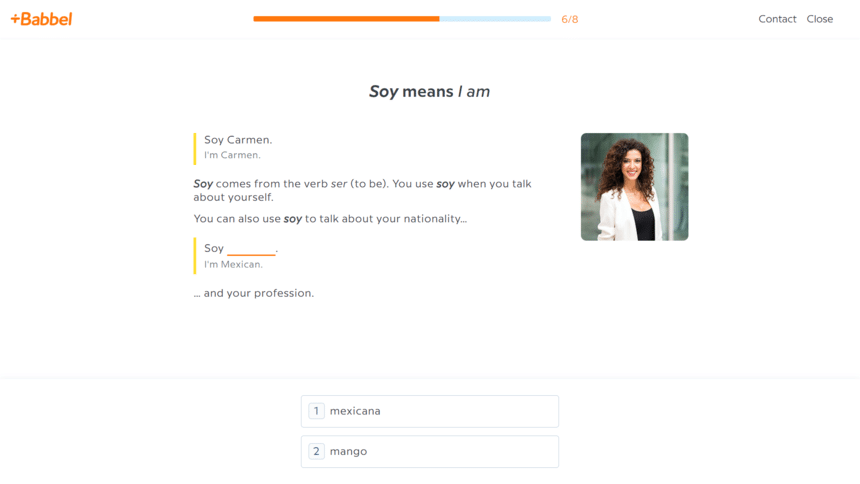
Here’s why: the Babbel lesson format is very different. Each lesson is made up of a series of several quick-hit, hands-on exercises.
The drills aren’t too different than what you’ll do with Rocket: listen-and-repeat exercises, digital flashcards, fill-in-the-blanks, matching pairs, matching phrases to images, and completing mock conversations. Short grammar tips are worked in throughout the lesson, so it’s never too much at once. You’re getting a quick, easy intro to the language without jumping straight into the in-depth audio work that Rocket has you do.
It’s a very diverse approach to learning that moves fast. Babbel basically presents the same content for a lesson in a variety of ways and forces you to engage with the material.
Plus, before each lesson, there’s a daily review session where you get spaced repetition and review of vocab you’ve already learned in past lessons, so you don’t have to worry about moving on before you’ve truly mastered the content.
Cost Comparison
Before discussing the strengths and weaknesses of each app, let’s quickly cover cost.
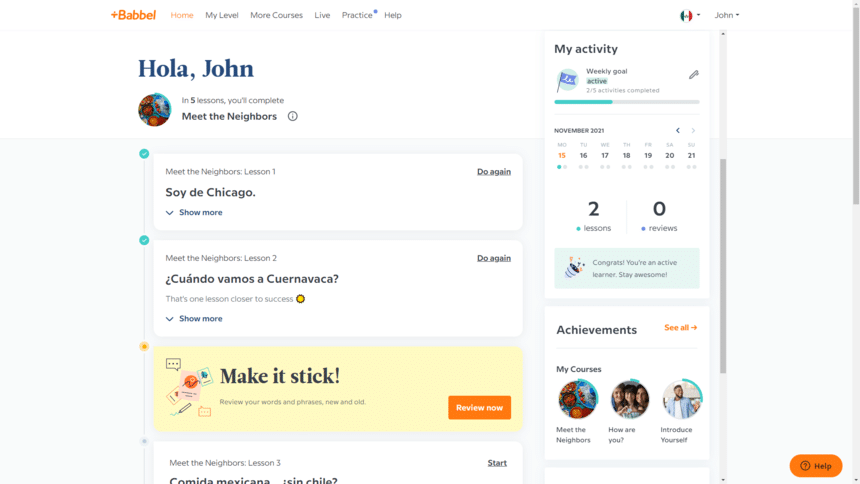
Babbel uses a pretty classic subscription model, which is fairly affordable. They offer three different plans:
- The 3-month plan costs about $15/mo
- The 6-month plan costs about $13/mo
- The 12-month plan costs about $8/mo
In addition, for those looking to learn two or three languages, or anyone who wants long-term access, Babbel also offers a one-time purchase, lifetime plan. That costs around $300 after discounts and includes access to all Babbel languages.
Rocket Languages doesn’t do the subscription model. They only offer one-time purchase, lifetime plans. Essentially, you buy it and get access forever.
These packages range from $150 to $450, depending on how many levels you want to purchase.
There’s no doubt about it: Babbel is cheaper. You’re looking at spending about $8 to $15 per month with Babbel vs a couple hundred dollars for a one-time buy with Rocket.
That being said, I would note that those prices for Rocket Languages are a little misleading, as they are just the MSRPs. In reality, Rocket Languages is almost always running some sort of deal or special promotion with steep discounts, and you can expect to save at least 50% on Rocket packages. Even Babbel is pretty aggressive with their discounting too, so make sure to check for coupons and links.
Reasons To Choose Rocket Languages
Now that we’ve covered pricing and laid out how each program works, let’s get into the major pros and cons of Rocket Languages and Babbel, as well as how they directly compare. Let’s start with Rocket Languages.
Audio Lessons With Fluent Speakers
The first clear highlight for Rocket Languages is their audio lessons. As noted, these audio lessons are the backbone of this program, and what makes Rocket different from most other language apps.
In my opinion, these audio lessons are incredibly engaging, as they do a great job getting you to actually think under pressure and verbalize what you’re learning.
One thing you’ll notice with a lot of other language apps, including Babbel, is that they don’t have large doses of listening or speaking exercises. In other words, there are no audio lessons.
Audio lessons literally make up three-quarters of the Rocket program content. To me, doing lots of listening is the most powerful way of truly internalizing a new language until you’re actually comfortable with it.
You have to hear a lot of your target language. And one of the coolest parts of the Rocket audio lessons is that when you’re done, you can then replay the underlying conversation that the lesson is built around in real time and take the part of one of the two actors. You’r practicing the exact kinds of conversations that you probably want to have in real life. Bottom line, their lessons definitely work.
Pronunciation Feedback
Another major highlight for Rocket is their speech recognition software. Between Rocket and Babbel, I much prefer Rocket’s speech tech.
Babbel’s software is good, but it’s fairly basic. Their conversation tool, Babbel Speak, guides you through scripted dialogues, which can be helpful if you’re nervous about getting started with speaking and want a little hand-holding while you jump in. But they don’t offer much if you’re looking for more freestyle conversation practice, and the voice recognition tech is just okay. It will tell you when you butcher a phrase and make you repeat it, but for the most part, it’s not super sensitive. It mostly says things like, “You made that sound easy” or, “You’re a pronunciation pro.”
It’s simply not the most helpful feedback in the world. In contrast, Rocket’s software is more sensitive, more accurate, and gives better feedback.
This is largely because Rocket uses Google’s web speech API for their underlying software, which is strong. It gives you a grade from 1 to 100 and will have you repeat phrases when you can’t hit a certain grade. If improving your pronunciation is important to you, definitely consider Rocket Languages.
Comprehensive Curriculum
The final strength of the Rocket program is the high-quality material. When you’re in each program doing lessons day in and day out, you can tell the Rocket coursework is more robust.
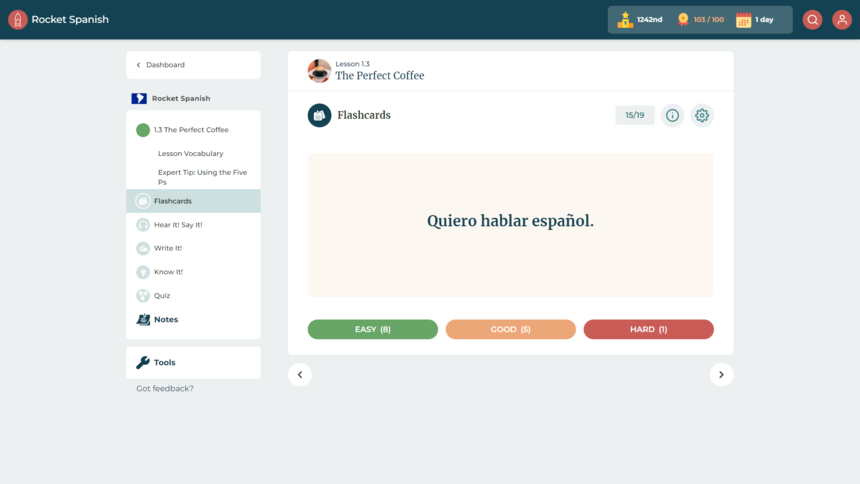
They offer detailed audio lessons, a nice variety of post-audio drills (like flashcards and quizzes), Language & Culture Lessons, and bonus tools, such as language survival kits and leaderboards.
I don’t mean to knock Babbel here, as I like their lessons, and they have some strong extras themselves (like podcasts and games), but it’s clear that the Rocket program is deeper and more immersive.
It feels more like a full academic program, whereas Babbel is more like a fun learning tool. Rocket takes language learning pretty seriously, which is why they get serious results.
Babbel
- Multiple Subscription Options
- Money Back Guarantee
Pros
- Short, engaging lesson format (15 minutes per lesson)
- Regular review sessions help with vocabulary retention
- More affordable than Rocket (as low as $8/mo after discounts)
- Grammar instruction integrated into curriculum
- App includes extra resources, like podcasts and a magazine
Cons
- Lessons could use more conversational practice
- Not ideal for advanced learners
Reasons To Choose Babbel
Now that we’ve discussed where Rocket’s program wins over Babbel, let’s get to my pros for choosing Babbel to learn a new language.
Variety of Practice Exercises
If you get bored easily, here’s what you’ll like most about Babbel’s program: the variety of drills. Rocket uses a decent mix of exercises after each audio lesson, but it’s always the same four or five basic drills on repeat.
The Babbel lessons are much more varied and surprising, which keeps things more balanced and fun. You never know if you’ll be working with images, filling in the end of a sentence, learning a new grammar rule, or jumping into a mock conversation.
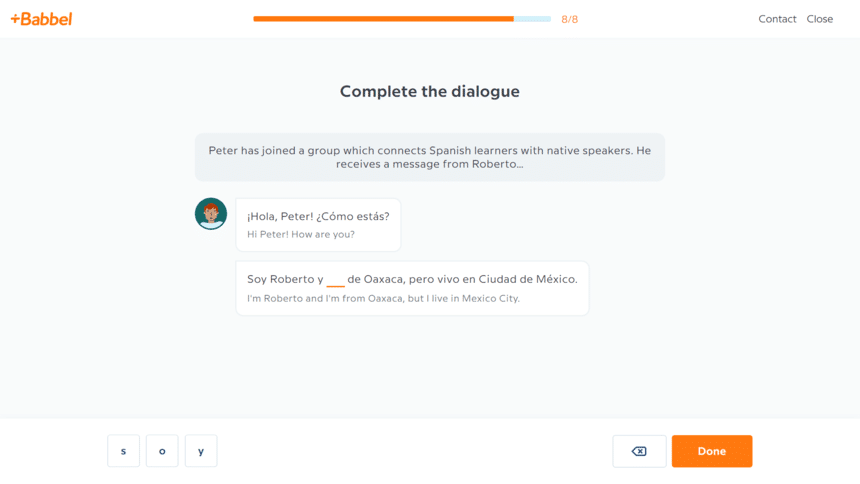
To me, the Babbel drills are great for keeping you engaged. And while that may sound like a minor point, you’re only going to keep learning if you can actually motivate yourself to log back in and get another lesson done. That’s why it’s key to choose an app that actually sounds interesting to you, rather than the one you feel like you’re supposed to be doing. For many learners, that means going with Babbel’s quick-hit lessons that keep you on your toes.
Shorter Lesson Format
If you’re a really busy person, the right program for you might simply be the one you have time for. I like that Babbel’s lessons are shorter.
To complete a full Rocket lesson (audio exercise plus the reinforcement drills), you’re looking at around a full hour. Of course, you can always pause a lesson part way through and come back later if you want, but I do prefer the short length of Babbel’s lessons.
They’re great for squeezing a lesson in on your lunch break, after dinner, or while waiting in the school pick-up line. At about 10-15 minutes each, they feel more manageable and less mentally taxing.
Review Sessions
The final highlight of the Babbel program is their daily review sessions. Every day when you log in to the Babbel app, you’re prompted to do a short review.
Basically, Babbel takes vocabulary from old lessons that you’ve completed and pulls it back in for a spaced review session. That way, over the course of the program, you’ll see every word or phrase you learn at least a half dozen or more times over several months.
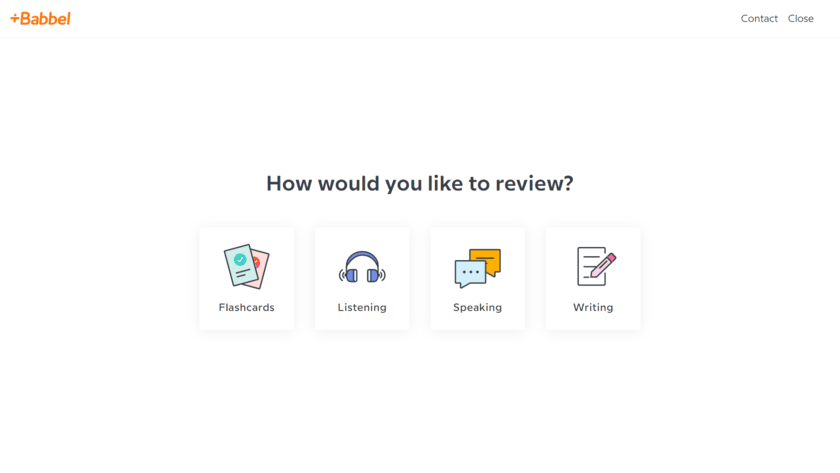
Plus, you can choose how you want to review: flashcards, listening, speaking, or writing. Listening is my personal favorite because you get some of those auditory benefits I noted above, but I do like that they give you options. This makes Babbel work really well for all kinds of personalities.
For reference, Rocket doesn’t have a formal vocab review system, so this is a nice advantage for Babbel. It’s a great way for getting you to remember and internalize new words and phrases.
Verdict: Babbel or Rocket Languages?
So what’s the better app: Rocket Languages or Babbel? To me, the answer is clearly Rocket, especially if you see yourself easily conversing with a native speaker. Rocket Languages is unmatched: they’ve got in-depth speaking and audio practice, concrete grammar lessons, and cultural background that gives you the whole picture.
Babbel might be easier on your budget and your schedule, particularly if you have a lot going on and don’t see yourself regularly sitting down for 30-minute chunks. But for most learners looking for the best language learning app on the market, that’s Rocket Languages. No program will get you comfortable in conversation faster than Rocket.
The lessons from Rocket Languages are longer and centered around interactive audio lessons with fluent speakers, while the Babbel lessons are shorter and include more variety in terms of drills and exercises. Rocket is also designed around listening and speaking practice, while Babbel focuses on helping you build a strong vocab and grammar foundation in a new language.
After using and testing out each language program, our team believes that Rocket Languages offers the more complete and effective language courses from top to bottom. Not only do the Rocket courses include detailed audio lessons with fluent speakers, but they also offer dedicated grammar lessons.
Yes, Babbel is more affordable than Rocket Languages. They offer monthly subscription plans as low as about $8 per month (after discounts), whereas Rocket Languages only offers lifetime packages.