

Our comprehensive guide about learning Japanese with Duolingo, including how long it takes, what to expect, and some tips and tricks.
So you want to learn Japanese? That’s great, but know what you’re getting yourself into. Japanese is one of only five languages on the planet classified as category IV, meaning that it is “exceptionally difficult” and will take a tremendous amount of time and effort to learn.
Now, the good news. No longer do you have to sit through night classes at the local community college. There are dozens of apps, online programs, podcasts, and YouTube channels to help you along your journey. Of all these resources, Duolingo might be the most popular. But does it actually work? In this post, I discuss how long it takes to learn Japanese with Duolingo.
Video: How Long It Took Us
In the video above, team member Bianca discusses how long it took our team to get through the Duolingo Japanese lessons.
How Much Time Per Day Should You Practice Japanese?
The best approach to learning Japanese is a hotly debated topic. Some linguists suggest full immersion and maximizing exposure to the language through nearly nonstop learning.
Other experts say doing just 30 minutes of language learning per day over an extended period of time allows your brain to absorb the language better. I tend to agree.
Hardly anyone has multiple hours per day for learning Japanese. That’s just not practical. Plus, I’m a big believer in consistency over volume.
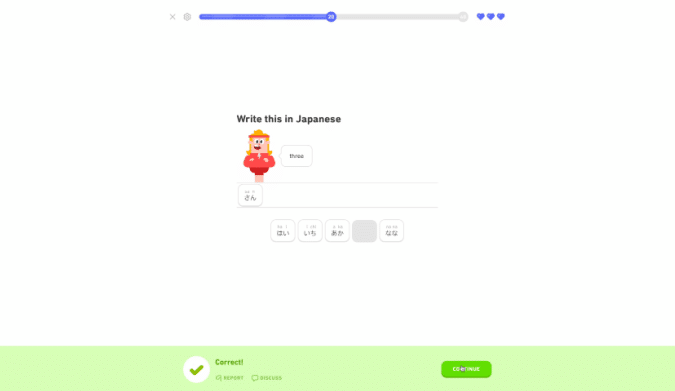
As long as you can dedicate 30 minutes per day five or six days per week, this should help you pick up Japanese at a relatively steady pace. Of course, because it’s a difficult language, you may want to dedicate more time to your studies if you want to pick it up faster for work or relocation purposes.
Also, for those who are learning for fun as a quirky hobby (looking at you anime fans out there), you can get away with 15 minutes per day.
In the end, there is no right amount of hours per day to practice. It is totally situational. Do what works for you depending on your schedule and how quickly you want to learn.
How Many Hours Does It Take To Learn Japanese with Duolingo?
Here’s the harsh reality. It takes around 2,200 hours to pick up Japanese. Yes, you read that correctly.
For reference, this is almost four times as long as it takes to learn simple languages like Spanish and French (Spanish takes just 600 hours).
For those who have used Duolingo before, you know that each lesson takes roughly 5 minutes. So by my math, if it takes 2,200 hours to learn Japanese, and each lesson takes 5 minutes to finish, you only need to complete 26,400 lessons.
Obviously, there is not a direct correlation between those 5 minute Duolingo lessons and that 2,200 hour figure, and there are tons of variables at play here (such as desired level of fluency), but just know that it will take a long time.
For your typical casual Duolingo user who does two or three lessons per day, I would bank on spending years on Duolingo to get to an intermediate level of Japanese fluency.
I have no doubt that you can master some basics within 6 months, but your conversations will be very elementary.
How Long Does It Take To Complete the Duolingo Japanese Course?
Unfortunately, there is no clear-cut answer as to how long it takes to complete the Duolingo Japanese course. For one, Duolingo is much more than a sequence of lessons. There are optional review sessions, match madness games, ramp ups, and league competition, among other features.
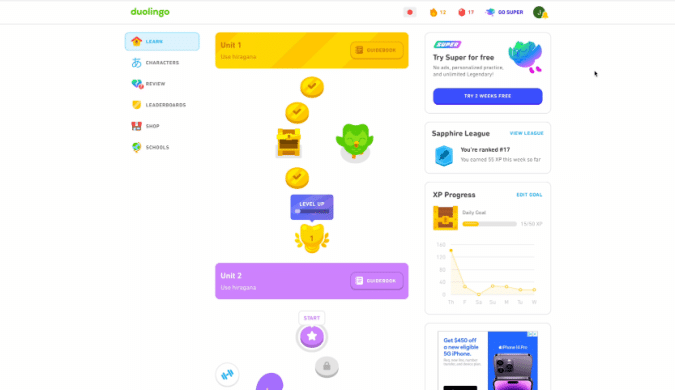
You can literally spend an hour on Duolingo and not do a single real lesson along the path. In this sense, I view Duolingo almost like a social app and less like a language app.
Even if you just did the lessons along the learning path, it would still take you two to three years at the rate of four lessons per day. It is a very long path (with over 200 units), with dozens of lessons per unit.
Tips For Learning Japanese with Duolingo
Studying Japanese is a challenge. However, it is not insurmountable. Part of your success will be based on preparing yourself for the journey (it really is a journey) and using the right resources, including Duolingo. Here are some tips to maximize your success.
First, take notes while you’re working through your lessons. Your brain retains more information when you’re taking manual notes on paper, as opposed to typing or simply swiping through an app. You should also set aside some time to drill any words you’re struggling with. Truly internalizing a language simply comes down to repetition.

Other success strategies include making a regular study schedule and setting realistic goals. You can’t just say, “I’ll study when I have time” with Japanese. That may be tempting when Duolingo makes it so easy, but you need a routine to help your brain and mouth remember all that you are learning. Set a schedule and stick to it, but don’t expect too much of yourself. Baby steps will get you there faster than overdoing it and completely burning yourself out.
Finally, consider upgrading. I know the free plan is tempting, but it won’t get you far. If you’re serious about Japanese, you might consider investing in Super Duolingo, which costs about $8 per month and removes the ads and limitations so you can make faster progress. For access to all Duolingo tools, including their AI conversation partner, Lily, you’ll have to pay about $30 for Duolingo Max. You might also look into some of the more effective apps out there. Babbel, for example, only costs about $8 to $15 per month but includes AI tools, speaking practice, direct grammar teaching, and much more powerful instruction.
Best Way To Supplement Duolingo When Learning Japanese
If you really want to master Japenese, you should take advantage of as many supplemental activities as possible. These include:
- Reading books (even children’s books are good)
- Watching TV, movies, and streaming content in Japanese (anime!)
- Using the captions while you watch (romaji or hiragana/katakana/kanji)
- Listening to music and reading lyrics
- Listening to podcasts, audiobooks, etc.
- Finding a good YouTube channel
- Reading the news in Japanese
- Using online translators, pronunciation apps, etc.
Japanese is not an easy language to learn, but you can do it if you make a smart plan and stick with it. Just know that Japanese is a long-term venture that requires some serious commitment. And if Duolingo isn’t getting you there quickly enough, check out more immersive approaches that focus on audio-centered lessons, like Rocket Japanese or Pimsleur.
That depends on a number of variables, including desired level of fluency, time commitment per day, and practice outside of Duolingo. For casual Duolingo users, expect to put in two to three years’ worth of work.
In theory Duolingo should be able to carry you to an intermediate level of fluency, but in practice, I haven’t found that to be the case. In my opinion, you will be hard pressed to surpass a level of A2 on Duolingo.
Duolingo says it can take you to a B1 or maybe B2 level of fluency, but I don’t see that as reality. I think you will at best become proficient at an A2 level.
Duolingo is constantly updating its courses, so it’s a bit of a moving target, but there are currently over 200 units in Duolingo Japanese.